

Farrow and Ball Dyrehaven vs. Sherwin Williams Pacer White
The colors, each unique in their hue and saturation, embody their own individual beauty and value. It's important to note that the colors have different hues. Farrow and Ball 9819 leans towards green hues, while Sherwin Williams SW 6098 is orange.
Sherwin Williams SW 6098 is more saturated than Dyrehaven
They differ in their values, with Farrow and Ball 9819 being darker.
Supported paint brands for comparison: Behr, Benjamin Moore, Farrow and Ball, Dulux, Jotun, Little Greene, NCS, Ral Classic, Ral Design, Ral Effect, Sherwin Williams, Valspar, Tikkurila
First color
Second color

| Farrow and Ball Dyrehaven | Sherwin Williams Pacer White |
|---|---|
| Shared hue scale | |
12 | |
| Hue | |
| 104°green | 37°orange |
| Saturation | |
| 9% | 29%more saturated |
| Lightness?Simple 0–100% measure derived from the minimum and maximum sRGB channels. Use CIE L* for perceptual lightness. | |
| 41% | 86%lighter |
| LRV?Light Reflectance Value measures the percentage of light reflected by a color, from 0 for absolute black to 100 for pure white. | |
| - | 72.79 |
| CIE L?Perceptual lightness. CIE Lab lightness ranges from 0 for black to 100 for diffuse white. | |
| 46.405 | 88.412looks lighter |
| Color difference ΔE*₀₀?CIE color difference. Smaller is closer: about 0–1 is imperceptible, 1–2 just noticeable, 2–5 a small difference, 5–10 clear, and more than 10 very different. | |
| 35.37 | |
| Temperature | |
| Cool | Warm |
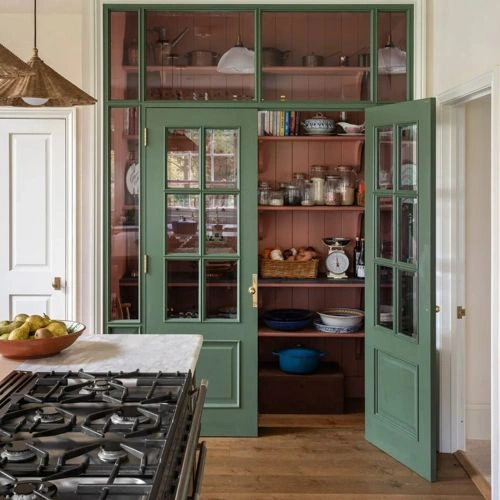


Please note that the color shown on this page is a representation and might not exactly match the real shade of the cards, fan decks, or color collections. Your monitor, browser, and screen angle can all affect how the paint looks, so it may not be the same as what you see here. All information on this page is based on RGB and HEX values provided by manufacturers.
It's important to keep in mind that the same color may appear differently on various surfaces due to the nature of those surfaces. For example, the same shade will look different on a rough wall compared to the smooth surface of cabinets.
Color comparisons featuring Farrow and Ball Dyrehaven

9819 Dyrehaven vs 1560 Antique Pewter


9819 Dyrehaven vs SW6187 Rosemary

9819 Dyrehaven vs 2047-10 Forest Green

9819 Dyrehaven vs P026 Rainforest Retreat

9819 Dyrehaven vs 651 Brazilian Rainforest

9819 Dyrehaven vs 2040-10 Rainforest Foliage

9819 Dyrehaven vs 80 Saxon Green

9819 Dyrehaven vs 78 Sutcliffe Green

9819 Dyrehaven vs 34 Calke Green

9819 Dyrehaven vs 15 Bone

9819 Dyrehaven vs 93 Studio Green

9819 Dyrehaven vs 2013 Matchstick

9819 Dyrehaven vs 213 Savage Ground

9819 Dyrehaven vs S 6010-G50Y

9819 Dyrehaven vs S 6010-G10Y

9819 Dyrehaven vs S 6010-G30Y

9819 Dyrehaven vs 2002 White Tie

9819 Dyrehaven vs RAL 7033 Cement grey

9819 Dyrehaven vs RAL 7043 Traffic grey B

9819 Dyrehaven vs 309 Whirlybird

9819 Dyrehaven vs 18 French Gray

9819 Dyrehaven vs 303 Templeton Pink

9819 Dyrehaven vs 231 Setting Plaster

9819 Dyrehaven vs 294 Sulking Room Pink

9819 Dyrehaven vs 234 Vert De Terre

9819 Dyrehaven vs HC-125 Cushing Green

9819 Dyrehaven vs RAL 7002 Olive grey

9819 Dyrehaven vs 290 Salon Drab

9819 Dyrehaven vs 266 Mizzle

9819 Dyrehaven vs HC-126 Avon Green

9819 Dyrehaven vs 446 Pinelands

9819 Dyrehaven vs 447 Holiday Wreath

9819 Dyrehaven vs SW6328 Fireweed

9819 Dyrehaven vs 313 Reduced Green

9819 Dyrehaven vs 310 Beverly