
Farrow and Ball Whirlybird vs. RAL Classic Patina green
We understand how important it is to remember the details. The colors, each with their own unique beauty and value, are truly special. Both colors belong to the green hue family, although their hue angles differ.
RAL Classic RAL 6000 is more saturated than Whirlybird
They differ in their values, Farrow and Ball 309 radiating a lighter essence compared to RAL 6000.
Supported paint brands for comparison: Behr, Benjamin Moore, Farrow and Ball, Dulux, Jotun, Little Greene, NCS, Ral Classic, Ral Design, Ral Effect, Sherwin Williams, Valspar, Tikkurila
First color
Second color

| Farrow and Ball Whirlybird | RAL Classic Patina green |
|---|---|
| Hue | |
| 97°green | 159°green |
| Saturation | |
| 16% | 32%more saturated |
| Lightness?Simple 0–100% measure derived from the minimum and maximum sRGB channels. Use CIE L* for perceptual lightness. | |
| 69% | 35%darker |
| LRV?Light Reflectance Value measures the percentage of light reflected by a color, from 0 for absolute black to 100 for pure white. | |
| 46.40 | 17.11looks darker |
| CIE L?Perceptual lightness. CIE Lab lightness ranges from 0 for black to 100 for diffuse white. | |
| 74.777 | 44.654looks darker |
| Color difference ΔE*₀₀?CIE color difference. Smaller is closer: about 0–1 is imperceptible, 1–2 just noticeable, 2–5 a small difference, 5–10 clear, and more than 10 very different. | |
| 28.593 | |
| Temperature | |
| Cool | Cool |


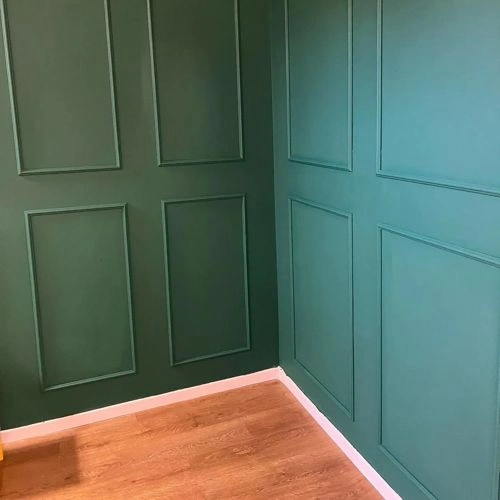

Please note that the color shown on this page is a representation and might not exactly match the real shade of the cards, fan decks, or color collections. Your monitor, browser, and screen angle can all affect how the paint looks, so it may not be the same as what you see here. All information on this page is based on RGB and HEX values provided by manufacturers.
It's important to keep in mind that the same color may appear differently on various surfaces due to the nature of those surfaces. For example, the same shade will look different on a rough wall compared to the smooth surface of cabinets.
Color comparisons featuring Farrow and Ball Whirlybird

309 Whirlybird vs 189 Carmine


309 Whirlybird vs RAL 6013 Reed green

309 Whirlybird vs RAL 6016 Turquoise green

309 Whirlybird vs RAL 6036 Pearl opal green

309 Whirlybird vs 6033 Emerald Sea

309 Whirlybird vs RAL 6034 Pastel turquoise

309 Whirlybird vs RAL 6027 Light green

309 Whirlybird vs 1563 Quiet Moments

309 Whirlybird vs SW6443 Relish

309 Whirlybird vs SW6442 Supreme Green

309 Whirlybird vs 6001-7C Green Supreme

309 Whirlybird vs SW6435 Gratifying Green

309 Whirlybird vs 90BG 30/073 Smoke Grey

309 Whirlybird vs SW6211 Rainwashed

309 Whirlybird vs H444

309 Whirlybird vs 443 Desert Green

309 Whirlybird vs 78 Sutcliffe Green

309 Whirlybird vs 77 Suffield Green

309 Whirlybird vs SW6245 Quicksilver

309 Whirlybird vs 80YR 83/035 Cappuccino Candy 6

309 Whirlybird vs 1620 Blue Heather

309 Whirlybird vs 2 Hound Lemon

309 Whirlybird vs SW6208 Pewter Green

309 Whirlybird vs 45YY 73/081 Bakers Flour

309 Whirlybird vs CC6 Hazy

309 Whirlybird vs 237 Cook's Blue

309 Whirlybird vs V106-5 Play Me a Melody

309 Whirlybird vs SW6190 Filmy Green

309 Whirlybird vs SW6492 Jetstream

309 Whirlybird vs 10003 White Tea

309 Whirlybird vs G7 Pond Green

309 Whirlybird vs 80 Saxon Green

309 Whirlybird vs CW-590 Williamsburg Wythe Blue

309 Whirlybird vs 271 Rolling Fog - Light

309 Whirlybird vs 160 Rolling Fog - Dark