
Farrow and Ball Shaded White vs. Sherwin Williams Hushed Auburn
We understand how important it is to remember the details. The colors, each with their own unique beauty and value, are truly special. It's important to note that the colors have different hues. Farrow and Ball 201 leans towards orange hues, while Sherwin Williams SW 9080 is red.
Farrow and Ball 201 and Sherwin Williams SW 9080 have pretty similar saturation.
They differ in their values, Farrow and Ball 201 radiating a lighter essence compared to SW 9080.
Supported paint brands for comparison: Behr, Benjamin Moore, Farrow and Ball, Dulux, Jotun, Little Greene, NCS, Ral Classic, Ral Design, Ral Effect, Sherwin Williams, Valspar, Tikkurila
First color
Second color

| Farrow and Ball Shaded White | Sherwin Williams Hushed Auburn |
|---|---|
| Hue | |
| 42°orange | 14°red |
| Saturation | |
| 24% | 21%less saturated |
| Lightness?Simple 0–100% measure derived from the minimum and maximum sRGB channels. Use CIE L* for perceptual lightness. | |
| 80% | 57%darker |
| LRV?Light Reflectance Value measures the percentage of light reflected by a color, from 0 for absolute black to 100 for pure white. | |
| 64.44 | 26.38looks darker |
| CIE L?Perceptual lightness. CIE Lab lightness ranges from 0 for black to 100 for diffuse white. | |
| 84.327 | 58.514looks darker |
| Color difference ΔE*₀₀?CIE color difference. Smaller is closer: about 0–1 is imperceptible, 1–2 just noticeable, 2–5 a small difference, 5–10 clear, and more than 10 very different. | |
| 24.121 | |
| Temperature | |
| Warm | Warm |


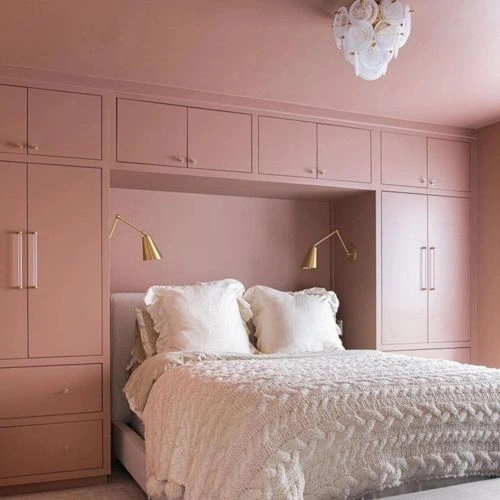
Please note that the color shown on this page is a representation and might not exactly match the real shade of the cards, fan decks, or color collections. Your monitor, browser, and screen angle can all affect how the paint looks, so it may not be the same as what you see here. All information on this page is based on RGB and HEX values provided by manufacturers.
It's important to keep in mind that the same color may appear differently on various surfaces due to the nature of those surfaces. For example, the same shade will look different on a rough wall compared to the smooth surface of cabinets.
Color comparisons featuring Farrow and Ball Shaded White

201 Shaded White vs 94 Carriage Green


201 Shaded White vs CW-425 Palace Ochre

201 Shaded White vs MQ2-18 Honey Tea

201 Shaded White vs SW7032 Warm Stone

201 Shaded White vs W1e Soft Wool

201 Shaded White vs N300-3 Casual Khaki

201 Shaded White vs MQ2-25 British Khaki

201 Shaded White vs 0314 Khaki Beige

201 Shaded White vs 1623 Marrakesh

201 Shaded White vs SW7562 Roman Column

201 Shaded White vs OC-56 Moonshine

201 Shaded White vs SW9504 Cold Foam

201 Shaded White vs SW9550 Mercurial

201 Shaded White vs X42R103A Beige Blush

201 Shaded White vs SW9612 Perfect Khaki

201 Shaded White vs SW6149 Relaxed Khaki

201 Shaded White vs 234 Crisp Khaki

201 Shaded White vs HC-114 Saybrook Sage

201 Shaded White vs 12313 Soft Dunes

201 Shaded White vs 2133-70 Tundra

201 Shaded White vs 10978 Alabaster White

201 Shaded White vs 11364 Century White

201 Shaded White vs SW9626 Glacier Bay

201 Shaded White vs SW9621 Clean Slate

201 Shaded White vs SW9636 Windchill

201 Shaded White vs SW9557 Autonomous

201 Shaded White vs SW9632 Serenely

201 Shaded White vs HC-147 Woodlawn Blue

201 Shaded White vs SW9629 Constellation

201 Shaded White vs 720C-2 Chocolate Froth

201 Shaded White vs AF-20 Mascarpone

201 Shaded White vs 90YY 73/040 Spiders Web

201 Shaded White vs R84B Feathers of a Dove

201 Shaded White vs 511 Pine Grove

201 Shaded White vs 2143-20 Alligator Green