

Farrow and Ball Tack Room Door G6
Contentsshow +hide -
| Official page: | Tack Room Door G6 |
| Code: | G6 |
| Name: | Tack Room Door |
| Brand: | Farrow and Ball |
What color is Farrow and Ball Tack Room Door?
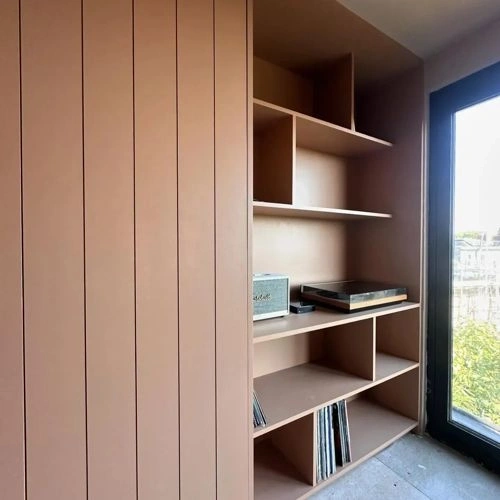
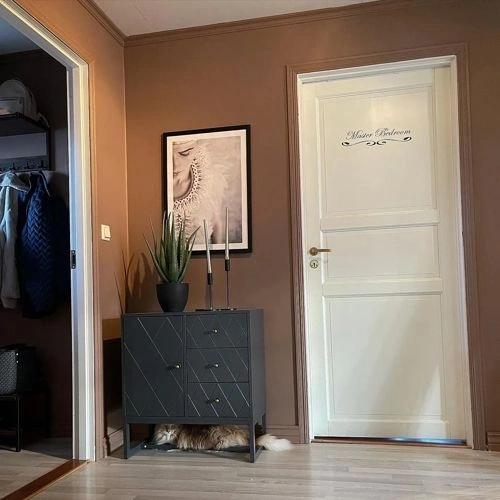
Farrow and Ball Tack Room Door G6 is a muted mid-tone brown with warm, earthy beige undertones and a softly weathered cast. Its low saturation keeps it from reading overly orange, giving the color a grounded, slightly greyed appearance. In bright daylight, Tack Room Door can show more of its sandy warmth, while lower or cooler light brings out its deeper brown-taupe side. It suits studies, hallways, mudrooms, and painted cabinetry where a substantial neutral is wanted without the heaviness of a dark chocolate shade. Pair it with creamy off-whites, aged brass, natural oak, linen upholstery, and charcoal details for a considered, material-rich scheme.
Try before you buy

100% accurate
reusable paint samples
Peel, stick,
and repeat
Twice painted
with real paint

Next day
delivery
What are Farrow and Ball Tack Room Door undertones?
Tack Room Door reads as a muted, mid-depth orange-brown with restrained saturation. Within its brown main family, it shows a relative lean toward red and yellow, giving it a warm undertone rather than a cool or gray one. Farrow & Ball describes it as a weathered mid-brown, which fits its visibly softened brown character, though the manufacturer does not name a specific undertone. Warm artificial light may bring out more of its orange-red warmth, while cool daylight can make it appear a little less warm and more subdued.
Manufacturer information used in this description: official color page.
HEX value:
RGB code:
157, 128, 103
Is Farrow and Ball Tack Room Door cool or warm?
warm
cool
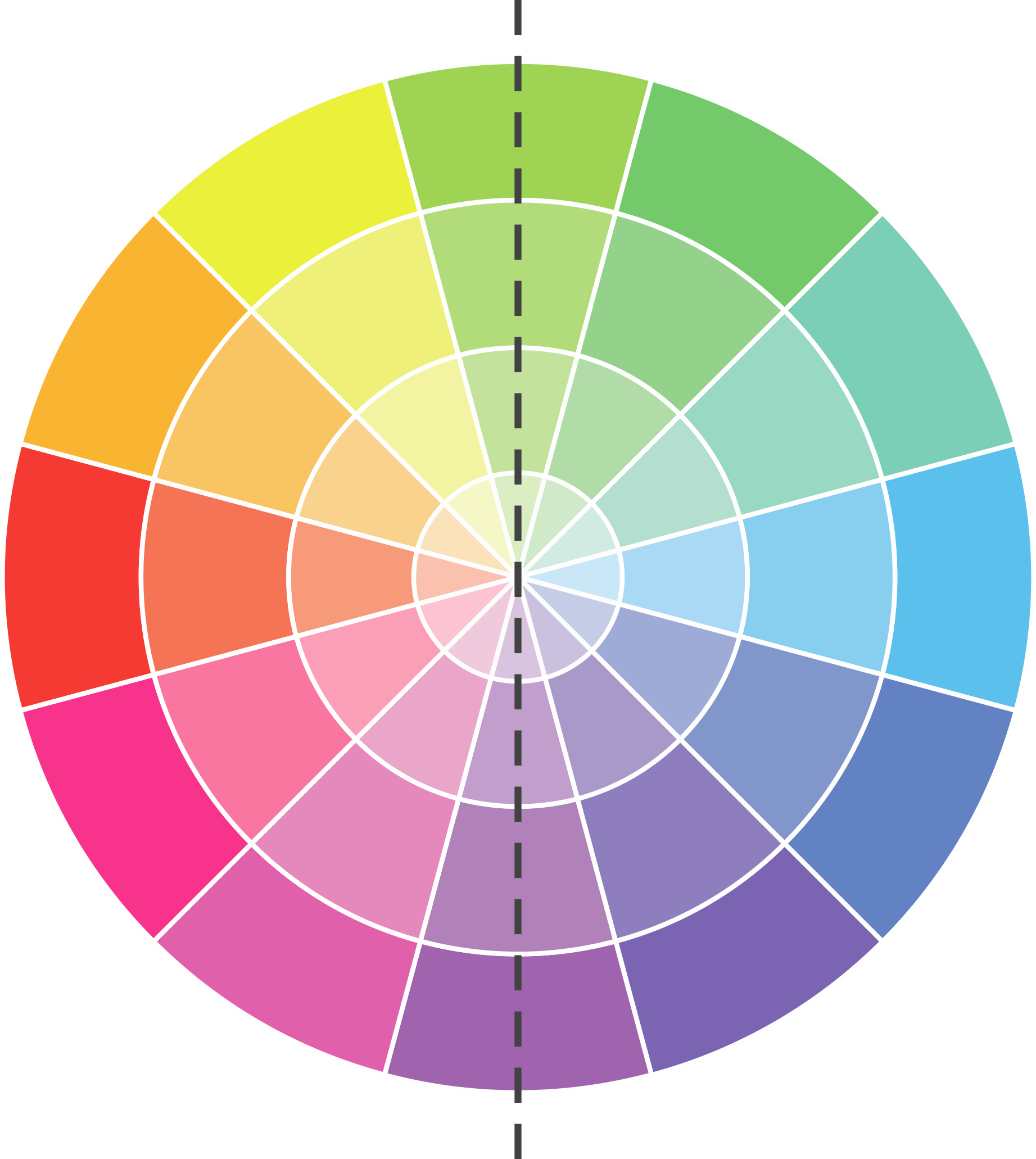
With a hue of 28°, this Red reads warm on the HSL color wheel.
G6 Tack Room Door HSL code: 28, 22%, 51%
Hue - degree on a color wheel from 0 to 360. 0 is red, 120 is green, and 240 is blue.
Saturation is expressed as a percentage. At 0%, it appears as a shade of grey, and at 100%, it is in full color.
Lightness is also a percentage value. 0% is black, and 100% is white.
How light temperature affects Tack Room Door
Natural Lighting. During the day, natural light shifts from about 2000 K at sunrise/sunset to 5500–6500 K at noon.
In addition, natural-light temperature depends on its direction:
| Direction of sunlight | Visible temp. | Hue | Duration |
|---|---|---|---|
| North | Cool | Bluish | All day |
| East | Warm | Yellow | Before noon |
| West | Warm | Orange-red | After noon |
| South | Warm | Orange-yellow | All day |
Artificial Lighting. When choosing bulbs, pay attention to their color temperature in Kelvins.
Use the slider to see how this Red shade looks under different lighting:
Coordinating colors.
Colors that go with Farrow and Ball Tack Room Door:
Monochromatic color scheme
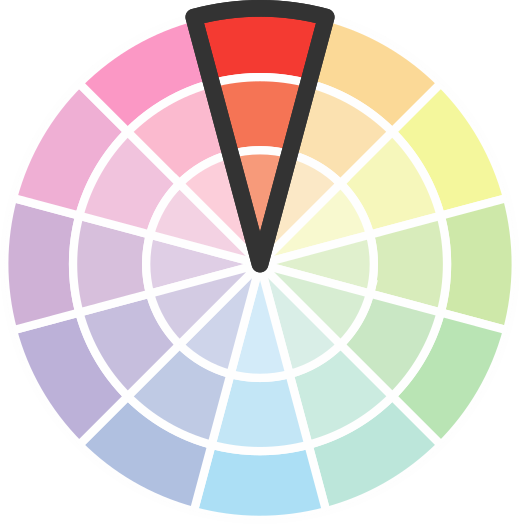
This scheme consists of various shades, tints, and tones of a single color. While it offers a perfect combination of hues, without accent décor it may become monotonous.
Lighter shades

Darker shades
G6
Tack Room Door

Complementary color scheme
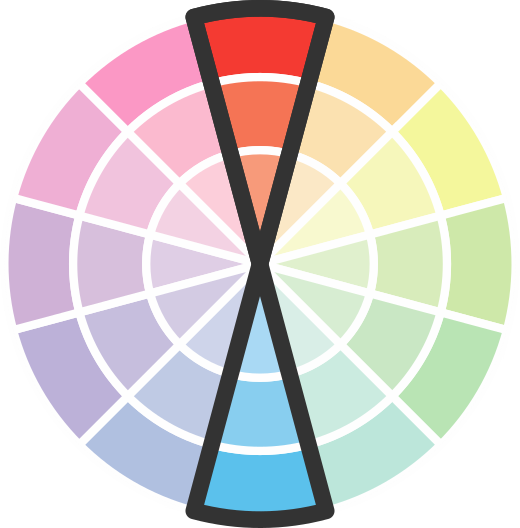
This color scheme is a combination of two shades that are opposite each other on the color wheel. The high contrast between these colors creates a vibrant and dynamic visual effect. For the color Tack Room Door with a red hue, complementary colors are those with a green hue close to 208, such as Farrow and Ball Black Blue and Hazy.
Color codes
We have collected almost every possible color code you could ever need.
Not sure what the difference between HEX and RGB is? We break down color models in plain language. Understanding color models
| Format | Code |
|---|---|
| HEX | #9d8067 |
| RGB Decimal | 157, 128, 103 |
| RGB Percent | 61.57%, 50.20%, 40.39% |
| HSV | Hue: 28° Saturation: 34.39% Value: 61.57% |
| HSL | hsl(28, 21.6, 50.98) |
| CMYK | Cyan: 0.0 Magenta: 18.47 Yellow: 34.39 Key: 38.43 |
| YIQ | Y: 133.821 I: 25.315 Q: -1.645 |
| XYZ | X: 24.072 Y: 23.587 Z: 16.113 |
| CIE Lab | L:55.672 a:7.417 b:17.784 |
| CIE Luv | L:55.672 u:20.321 v:21.514 |
| Decimal | 10322023 |
| Hunter Lab | 48.566, 3.484, 14.326 |

Color equivalents
11175
Adventure
Jotun


00YY 26/220
Spiced Honey
Dulux


80YR 27/147
Expresso Delight 2
Dulux
341
Split Pink
Little Greene
20YY 24/177
Caramel Sand 1
Dulux
12YY 28/226
Brass Buckle
Dulux
12198
Earthy
Jotun
S471
Etruscan
Tikkurila

20120
Organic Red
Jotun
80YR 30/187
Cappuccino Candy 2
Dulux
S484
Conglomerate
Tikkurila

54
Dauphin
Farrow and Ball
30YY 27/226
Bracken Salts 1
Dulux
10YY 23/261
Soft Maplewood 1
Dulux
10001
Dijon Yellow
Jotun
20YY 23/246
Labrador Sands 1
Dulux
90YR 23/274
Soft Almond 1
Dulux
RAL 1019
Grey beige
RAL Classic
