

Farrow and Ball Preferenced Red vs. Little Greene Portland Stone - Dark
The colors, each unique in their hue and saturation, embody their own individual beauty and value. It's important to note that the colors have different hues. Farrow and Ball 297 leans towards red hues, while Little Greene 157 is yellow.
Farrow and Ball 297 and Little Greene 157 differ significantly in saturation. Farrow and Ball 297 is more saturated.
They differ in their values, with Farrow and Ball 297 being darker.
Supported paint brands for comparison: Behr, Benjamin Moore, Farrow and Ball, Dulux, Jotun, Little Greene, NCS, Ral Classic, Ral Design, Ral Effect, Sherwin Williams, Valspar, Tikkurila
First color
Second color

| Farrow and Ball Preferenced Red | Little Greene Portland Stone - Dark |
|---|---|
| Shared hue scale | |
12 | |
| Hue | |
| 353°red | 51°yellow |
| Saturation | |
| 25% | 17%less saturated |
| Lightness?Simple 0–100% measure derived from the minimum and maximum sRGB channels. Use CIE L* for perceptual lightness. | |
| 34% | 56%lighter |
| LRV?Light Reflectance Value measures the percentage of light reflected by a color, from 0 for absolute black to 100 for pure white. | |
| 8.20 | 32.55looks lighter |
| CIE L?Perceptual lightness. CIE Lab lightness ranges from 0 for black to 100 for diffuse white. | |
| 33.142 | 64.091looks lighter |
| Color difference ΔE*₀₀?CIE color difference. Smaller is closer: about 0–1 is imperceptible, 1–2 just noticeable, 2–5 a small difference, 5–10 clear, and more than 10 very different. | |
| 40.502 | |
| Temperature | |
| Warm | Warm |


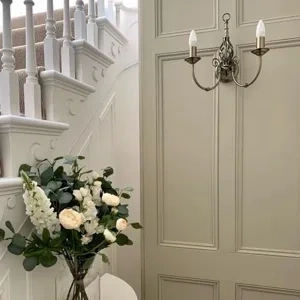

Please note that the color shown on this page is a representation and might not exactly match the real shade of the cards, fan decks, or color collections. Your monitor, browser, and screen angle can all affect how the paint looks, so it may not be the same as what you see here. All information on this page is based on RGB and HEX values provided by manufacturers.
It's important to keep in mind that the same color may appear differently on various surfaces due to the nature of those surfaces. For example, the same shade will look different on a rough wall compared to the smooth surface of cabinets.
Color comparisons featuring Farrow and Ball Preferenced Red

297 Preferenced Red vs SW7010 White Duck


297 Preferenced Red vs SW7702 Spiced Cider

297 Preferenced Red vs SW7701 Cavern Clay

297 Preferenced Red vs 2124-10 Wrought Iron

297 Preferenced Red vs 203 Tallow

297 Preferenced Red vs 2846 Bordeaux

297 Preferenced Red vs S 6030-R10B

297 Preferenced Red vs 67 Farrow's Cream

297 Preferenced Red vs SW9643 Eventide

297 Preferenced Red vs SW6239 Upward

297 Preferenced Red vs X19R32F Deep Aubergine

297 Preferenced Red vs X20R45F Ruby Begonia

297 Preferenced Red vs 1163 Tissue Pink

297 Preferenced Red vs 247 Terre d' Egypte

297 Preferenced Red vs G13 Mortar Pink

297 Preferenced Red vs 53 Cane

297 Preferenced Red vs 36 Mahogany

297 Preferenced Red vs X21R46F Sailor's Delight

297 Preferenced Red vs S 6030-R

297 Preferenced Red vs SW2902 Elderberry

297 Preferenced Red vs S 6030-Y90R

297 Preferenced Red vs W93 Crimson Red

297 Preferenced Red vs 10BB 15/154 Niagara Blues 1

297 Preferenced Red vs 221 Pantalon

297 Preferenced Red vs W5b Chestnuts in the Park

297 Preferenced Red vs X8R24F Cherry Cola

297 Preferenced Red vs X22R47E Cherry Macaron

297 Preferenced Red vs 292 Treron

297 Preferenced Red vs 220 Pitch Blue

297 Preferenced Red vs 88 Lamp Room Gray

297 Preferenced Red vs OC-85 Mayonnaise

297 Preferenced Red vs SW9041 Parisian Patina

297 Preferenced Red vs 2104-30 Harvest Brown

297 Preferenced Red vs PPU5-08 Sculptor Clay

297 Preferenced Red vs 1008-5A Muted Red