

Farrow and Ball Titmouse Blue W24
Contentsshow +hide -
| Official page: | Titmouse Blue W24 |
| Code: | W24 |
| Name: | Titmouse Blue |
| Brand: | Farrow and Ball |
What color is Farrow and Ball Titmouse Blue?
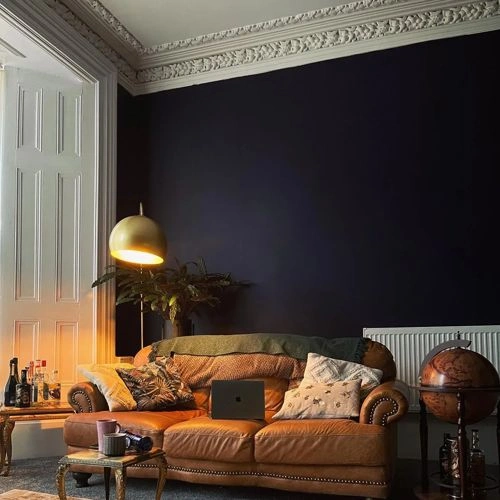
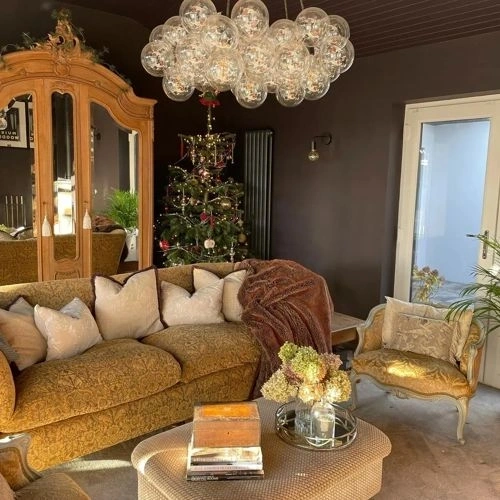
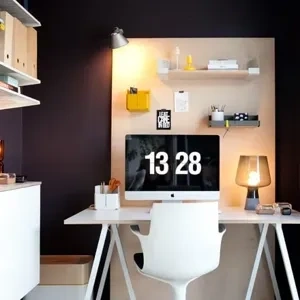
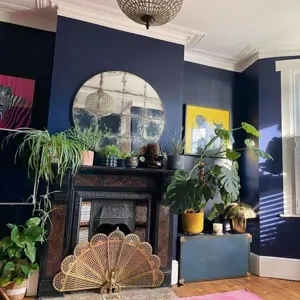
Farrow and Ball Titmouse Blue W24 is a deep, muted blue with a noticeable charcoal cast and a faint violet lean. Its low brightness gives it a weighty, enveloping presence, especially in rooms with limited natural light, where it can read almost like a softened black-blue. In brighter daylight, the blue character becomes clearer while the restrained saturation keeps it from feeling overly bold. Use this shade on a study wall, library cabinetry, or a dining room ceiling for definition without a sharp contrast. Pair it with warm off-whites, weathered oak, brushed brass, or pale stone to bring out its quiet blue undertone.
Try before you buy

100% accurate
reusable paint samples

Peel, stick,
and repeat

Twice painted
with real paint

Next day
delivery
What are Farrow and Ball Titmouse Blue undertones?
Titmouse Blue reads as a deep, very muted blue-purple, with a low-saturation, charcoal-like overall character rather than a bright blue appearance. In the supplied digital sample, the subtle bias leans purple, though that shift is restrained and can be hard to separate from the color’s darkness. Farrow & Ball’s provided description calls it a color with a “smart look” and “luxurious atmosphere,” but it does not state a specific undertone. Warm artificial light may draw out its subdued red-purple cast, while cool daylight can make its blue side appear more noticeable.
Manufacturer information used in this description: official color page.
HEX value:
RGB code:
63, 62, 76
Is Farrow and Ball Titmouse Blue cool or warm?
warm
cool
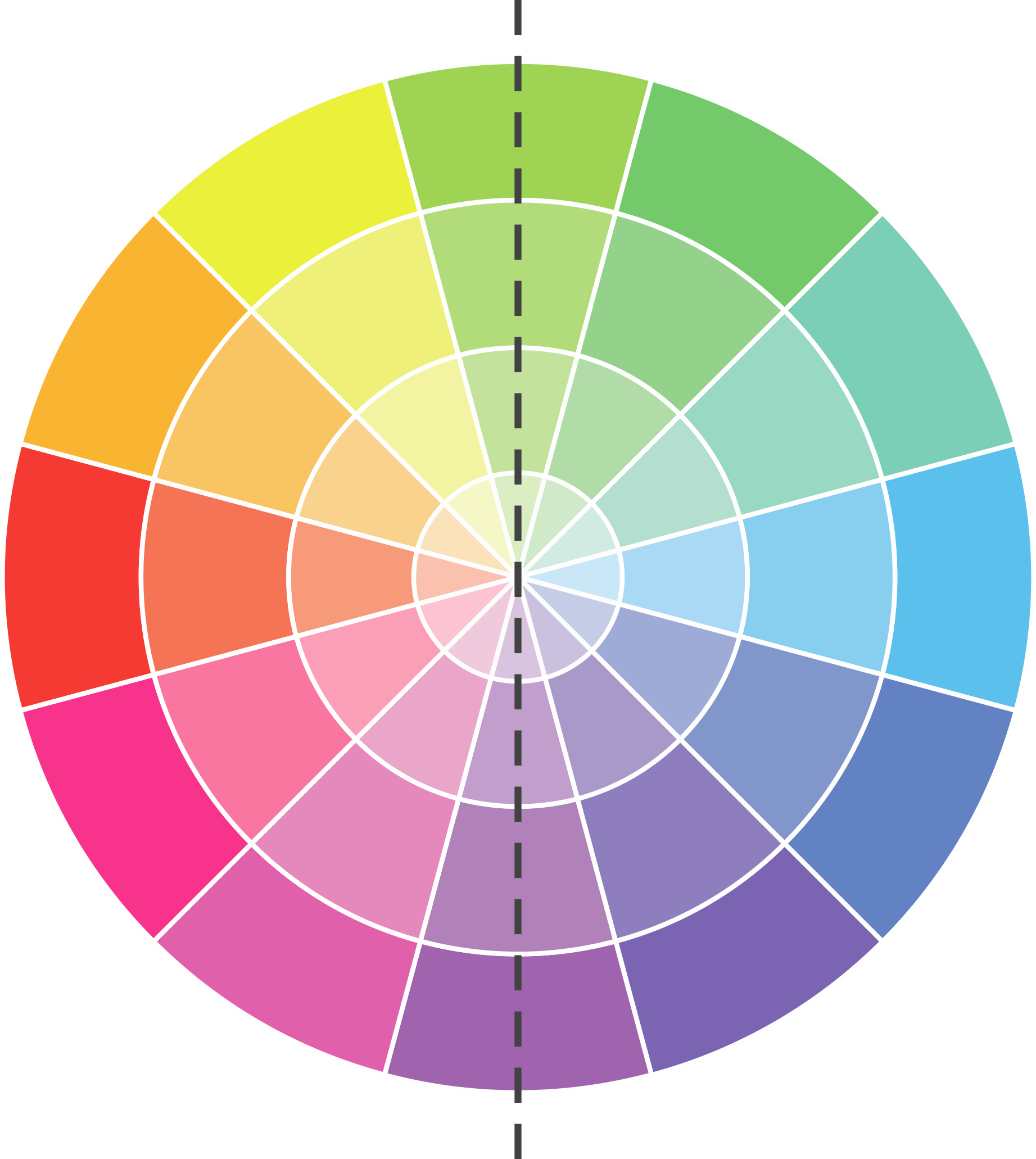
With a hue of 244°, this dark blue leans cool, but it is near the neutral line and may feel warmer in certain lighting.
W24 Titmouse Blue HSL code: 244, 10%, 27%
Hue - degree on a color wheel from 0 to 360. 0 is red, 120 is green, and 240 is blue.
Saturation is expressed as a percentage. At 0%, it appears as a shade of grey, and at 100%, it is in full color.
Lightness is also a percentage value. 0% is black, and 100% is white.
How light temperature affects Titmouse Blue
Natural Lighting. During the day, natural light shifts from about 2000 K at sunrise/sunset to 5500–6500 K at noon.
In addition, natural-light temperature depends on its direction:
| Direction of sunlight | Visible temp. | Hue | Duration |
|---|---|---|---|
| North | Cool | Bluish | All day |
| East | Warm | Yellow | Before noon |
| West | Warm | Orange-red | After noon |
| South | Warm | Orange-yellow | All day |
Artificial Lighting. When choosing bulbs, pay attention to their color temperature in Kelvins.
Use the slider to see how this dark blue shade looks under different lighting:
Coordinating colors.
Colors that go with Farrow and Ball Titmouse Blue:
Monochromatic color scheme
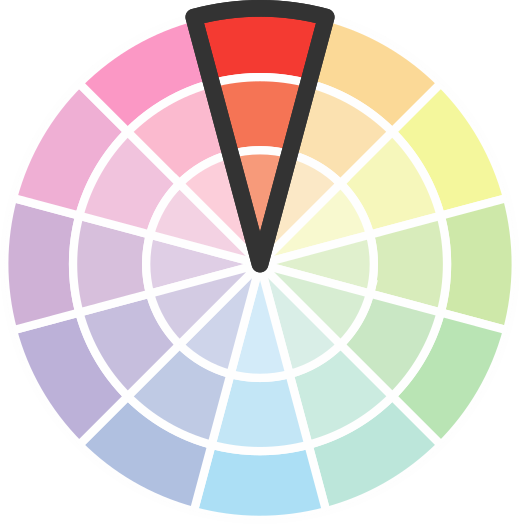
This scheme consists of various shades, tints, and tones of a single color. While it offers a perfect combination of hues, without accent décor it may become monotonous.
Lighter shades
W24
Titmouse Blue

Complementary color scheme
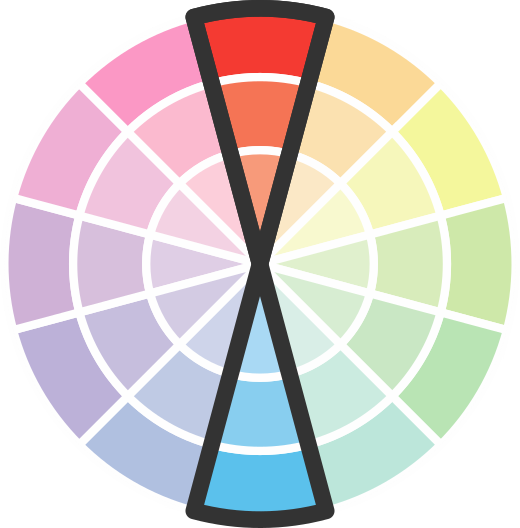
This color scheme is a combination of two shades that are opposite each other on the color wheel. The high contrast between these colors creates a vibrant and dynamic visual effect. For the color Titmouse Blue with a blue hue, complementary colors are those with a orange hue close to 64, such as Farrow and Ball Tunsgate Green and Vert De Terre.



Color codes
We have collected almost every possible color code you could ever need.
Not sure what the difference between HEX and RGB is? We break down color models in plain language. Understanding color models
| Format | Code |
|---|---|
| HEX | #3f3e4c |
| RGB Decimal | 63, 62, 76 |
| RGB Percent | 24.71%, 24.31%, 29.80% |
| HSV | Hue: 244° Saturation: 18.42% Value: 29.8% |
| HSL | hsl(244, 10.14, 27.06) |
| CMYK | Cyan: 17.11 Magenta: 18.42 Yellow: 0.0 Key: 70.2 |
| YIQ | Y: 63.895 I: -3.903 Q: 4.568 |
| XYZ | X: 5.077 Y: 5.024 Z: 7.538 |
| CIE Lab | L:26.802 a:3.807 b:-8.324 |
| CIE Luv | L:26.802 u:-0.271 v:-10.301 |
| Decimal | 4144716 |
| Hunter Lab | 22.414, 1.206, -4.25 |
Color equivalents
225
Bible Black
Farrow and Ball

Black Plum
Dulux
30RB 07/107
Plum Compote
Dulux
10RB 08/125
Amethyst Falls 1
Dulux
46RB 06/074
Galactic Sky
Dulux
Oxford Blue (Heritage)
Dulux
66BB 06/077
Black Opal
Dulux
Sapphire Splendor
Dulux
294
Paean Black
Farrow and Ball
M350
Ink
Tikkurila

50RB 09/087
Twilight Cinders 1
Dulux
RAL 5008
Grey Blue
RAL Classic

10RB 10/116
Brooklyn Nights 1
Dulux
X502
Lair
Tikkurila
Deepest Burgundy
Dulux
252
Dock Blue
Little Greene
254
Pelt
Farrow and Ball

23RB 10/134
Baked Aubergine
Dulux